














 Département d’éducation physique d’éducation
 Département des sciences végétales
 Département de science politique
  Département de psychiatrie
 Département de radiologie
 Département de Sociologie
 Département de Génie des Sols et Agroalimentaire
 Département de chirurgie
 Département de Sciences du bois et de la forêt












[FSG] Faculty é of Sciences G é nies & Environment Department
1.- CURRICULUM
This program offers a typical full-time path spanning 2 years (4 sessions). Students wishing to continue their studies part-time are invited to contact the Faculty’s resource person. The program totals 60 credits, including 15 credits for the technical and scientific research project.
|
RURAL ENGINEERING MASTER / CONCENTRATION SOIL FEEDING / 60 credits
Compulsory courses |
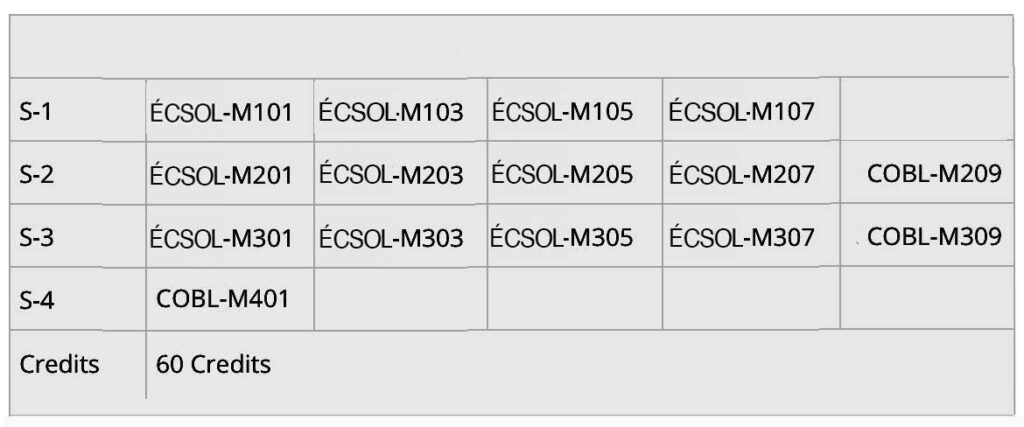
- COBL-M209 Technical Writing Methodology (3)
- COBL-M309 Research Quote / Dissertation (3)
- COBL-M401 Defense / Thesis (15)
2. OBJECTIVES
This program can be applied to environmental science of soils in general and to environmental protection in agricultural, urban and industrial environments. It will allow you to acquire theoretical and practical scientific knowledge. This professional program consists of courses, internships and a trial. You will present your synthesis work in the form of an essay that will focus on a problem raised during your internship.
3.- COURSE DESCRIPTION
Theories of flow in saturated and unsaturated porous media. Application of the appropriate differential equations to drainage and infiltration problems. Construction and analysis of water balance models in soils.
Characterization of contaminant sources. Transport mechanisms and physicochemical attenuation processes of contaminants in groundwater. Flow and transport models. Vulnerability of natural land to contamination. Laboratory and field methods for the evaluation of transport parameters.
Groundwater management: principles and applications. Prevention of contamination. Detection of contamination. Establishment of decontamination criteria. Bioremediation. Water recovery and treatment. Haitian policies and regulations. Case stories.
Soil management: principles and applications. Prevention of contamination. Detection of contamination. Establishment of decontamination criteria. Bioremediation. Soil recovery and treatment. Haitian policies and regulations. Case stories.
The course covers wastewater treatment systems, in particular: preliminary and primary treatments as well as the activated sludge process (removal of carbon and nitrogen). At the end of this course, the student will be able to design all the elements of the wastewater collection networks. Hydraulic characteristics of flows in sewer lines. Urban runoff. Volumes and flows of sanitary wastewater. Sewage system design standards. Hydraulic design of sanitary and storm sewer networks.
At the end of this course, the student will be able to design all the elements of drinking water distribution networks. Hydraulic characteristics of flows in water distribution pipes. Consumption water volumes and flow rates. Collection, supply and distribution of drinking water. Design of a drinking water distribution network. Pipe auscultation techniques. Rehabilitation of aqueduct pipes. Laboratory sessions and practical work on the application of network design rules. Session projects on manual and computer design of wastewater distribution and collection networks.
Environmental geotechnics: retaining structures (earthen dikes) (design and construction), slope stability, environmental barriers, site characterization tools (piezocone, permeameter, resistivity cone) geomembranes, geotextiles, soil improvement (injection, trench of mud).
This course deals with research, its place in society as well as its achievement, researchers and communication, within the framework of research. It is divided as follows: scientific research and society; knowledge structure; organization of scientific research; carrying out the research; communication of research results; master’s and doctoral studies; ethics in research.
This seminar takes place before an assembly of professors, students and outsiders. During the seminar, the master’s student presents the main part of his research work and brings out the main conclusions. This presentation makes it possible to have discussions likely to orient and improve the student’s research. The central theme is: Infrastructures.
This seminar takes place before an assembly of professors, students and outsiders. During the seminar, the master’s student presents the main part of his research work and brings out the main conclusions. This presentation makes it possible to have discussions likely to orient and improve the student’s research. The central theme is: soil nourishment.
This seminar takes place before an assembly of professors, students and outsiders. During the seminar, the master’s student presents the main part of his research work and brings out the main conclusions. This presentation makes it possible to have discussions likely to orient and improve the student’s research. The central theme is: soil restoration.
This seminar takes place before an assembly of professors, students and outsiders. During the seminar, the master’s student presents the main part of his research work and brings out the main conclusions. This presentation makes it possible to have discussions likely to orient and improve the student’s research. The central theme is: Soil management and rehabilitation.
The Research Quote is a summary work carried out under the direction of a professor from the program. It relates to a specific question related to the field of environmental soil sciences, or to a problem raised during the student’s internship. It is evaluated by the professor who supervises the student according to the directives mentioned in the course plan of the responsible professor. The end-of-study report can take several forms: carrying out a pilot experiment on a specific theme, carrying out a short scientific research assignment in one or more of the fields or axes of research in environmental soil sciences , etc.
COBL-M401. Master’s thesis defense (15 cr.)
Information
PROGRAMS
DEGREES
The bachelor’s degree in civil engineering will give you the tools that will allow you to meet the challenges of this field. Your training will allow you to assimilate the fundamental subjects of civil engineering, from the mechanics of deformable solids to the environment, including hydraulics, soil mechanics and project management. Bachelor of Civil Engineering (B. Ing.)
The civil engineer must sometimes specialize before tackling highly complex technical challenges. You will have the chance to study in a stimulating research environment including several laboratories in hydraulics, environment, geotechnics and structure and concrete.
The doctoral program will allow you to specialize in a field of civil engineering while acquiring specific training in research. Students have access to several laboratories with state-of-the-art facilities and equipment.
This bachelor’s degree will give you the tools you need to prevent pollution and alteration of the aquatic environment. The particularity of water engineering is its marked orientation towards integrated and sustainable water management.
Civil engineers today face the challenge of building and maintaining sustainable infrastructure. Water is one of the world’s essential resources. The objective of this study program assesses the evolution of water problems facing us and future generations.
Learn in this program about:
-
- Hydrology
- Water resources
- Management of infrastructure and public services
Be prepared to deal with infrastructure issues and evolving water issues. You will acquire the skills to take advantage of engineering concepts and computer technology to create a more sustainable infrastructure.
You will have the chance to study in a dynamic research environment comprising several laboratories in hydraulics, environment and geotechnics. You will meet students from various backgrounds and you will acquire knowledge in various disciplines relevant to environmental sciences. You will carry out teamwork and integration projects, which will open you up to interdisciplinary work in the environment.
This program will provide you with comprehensive training as a specialist in the design and operation of electrical and electronic systems. You will acquire the theoretical knowledge necessary for the study and design of technological systems as well as the experimental working methods required by the engineering profession.
The Department of Electrical Engineering and Computer Engineering trains engineers and specialists in a wide variety of advanced technological fields. Thanks to the numerous research and development projects carried out in collaboration with industry and certain research centers, the training courses are well anchored in the reality of the environment.
You will perfect your skills in one of the fields of electrical engineering and you will contribute, through the results of your research, to the progress of science. The Department of Electrical Engineering and Computer Engineering trains engineers and specialists in a wide variety of advanced technological fields.
This program will make you a specialist in hardware and software design of computer devices and systems. You will assimilate in particular the theoretical notions of signal and information processing as well as the architecture and organization of computer systems.